A telescope is an optical instrument that uses lenses, curved mirrors, or a combination of the two to watch distant objects, or other devices that employ electromagnetic radiation to observe distant objects through their emission, absorption, or reflection. Refracting telescopes, which used glass lenses and were invented in the Netherlands at the beginning of the 17th century, were the earliest known usable telescopes. They were employed for both terrestrial and astronomical purposes.
Within a few decades of the original refracting telescope, the reflecting telescope was invented, which collects and focuses light using mirrors. Many new types of telescopes were invented in the twentieth century, including radio telescopes in the 1930s and infrared telescopes in the 1960s. The term “telescope” currently encompasses a wide range of instruments capable of detecting various parts of the electromagnetic spectrum, as well as other types of detectors in some circumstances.
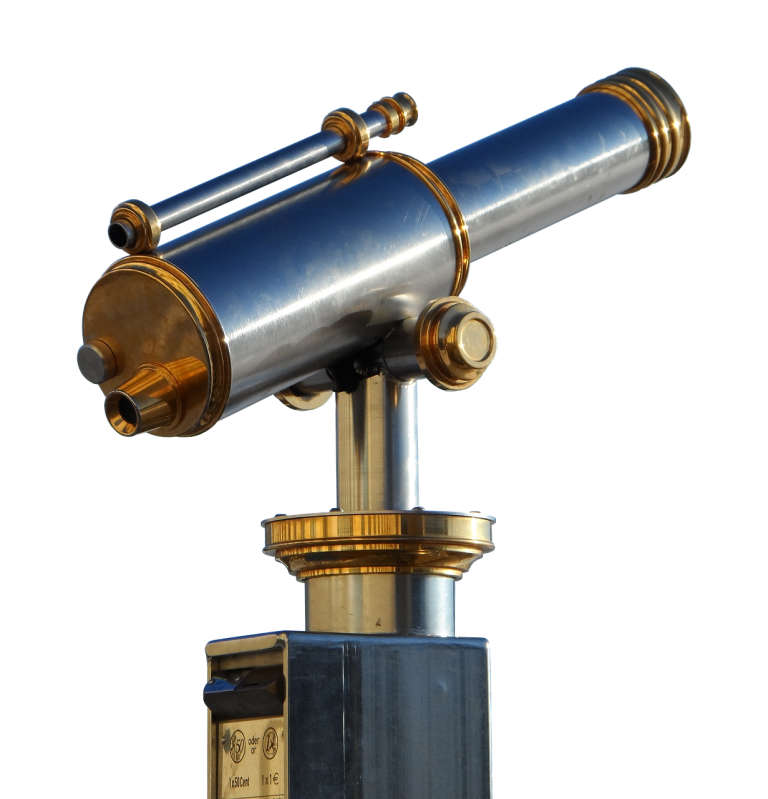
Table of Contents
Etymology
The name telescope (from the Ancient Greek tele “far” and o, skopein “to look or see”;, teleskopos “far-seeing”) was invented in 1611 by the Greek mathematician Giovanni Demisiani for one of Galileo Galilei’s instruments exhibited at an Accademia dei Lincei supper. Galileo used the term perspicillum in the Starry Messenger.
History
The first known documentation of a telescope is a patent for a refracting telescope submitted to the Dutch government in 1608 by Middelburg spectacle manufacturer Hans Lippershey. Although the exact inventor is unknown, word of the invention traveled throughout Europe. Galileo learned of it and created his own version in 1609, using it to make telescopic observations of celestial objects.
Soon after the discovery of the refracting telescope, the idea that the objective, or light-gathering element, could be a mirror instead of a lens was explored. The theoretical benefits of employing parabolic mirrors—the reduction of spherical aberration and the absence of chromatic aberration—led to a slew of proposed designs and attempts to build reflecting telescopes. In 1668, Isaac Newton created the first workable reflecting telescope, the Newtonian reflector, which bears his name.
The achromatic lens was invented in 1733 and allowed for the building of shorter, more practical refracting telescopes by partially correcting color distortions present in the simple lens. Reflecting telescopes were restricted by the use of swiftly tarnishing speculum metal mirrors in the 18th and early 19th centuries, which was solved by the advent of silver coated glass mirrors in 1857 and aluminized mirrors in 1932. Because refracting telescopes have a physical size limit of around 1 meter (40 inches), the vast majority of large optical research telescopes produced since the start of the twentieth century have been reflectors. The largest reflecting telescopes now have objectives larger than 10 m (33 ft), and several 30-40m versions are in the works.
Telescopes that worked in a wide variety of wavelengths from radio to gamma-rays were also developed during the twentieth century. In 1937, the first purpose-built radio telescope was put into service. Since then, a wide range of sophisticated astronomy devices has been created.
Types
The term “telescope” refers to a variety of instruments. Although most sense electromagnetic radiation, astronomers must collect light (electromagnetic radiation) in different frequency bands in different ways.
The wavelengths of light detected by telescopes can be categorised as follows:
- Shorter wavelengths than ultraviolet light are used in X-ray telescopes.
- Ultraviolet telescopes use wavelengths that are shorter than visible light.
- Optical telescopes are telescopes that use visible light.
- Longer wavelengths than visible light are used by infrared telescopes.
- Microwave wavelengths longer than infrared light are used in submillimetre telescopes.
- Even longer-wavelength radio telescopes are being developed.
The utilization of antenna technology to interact with electromagnetic radiation becomes easier as wavelengths increase longer (although it is possible to make very tiny antenna). Near-infrared light can be gathered similarly to visible light, while telescopes in the far-infrared and submillimetre range can function more like radio telescopes. The James Clerk Maxwell Telescope, for example, observes wavelengths ranging from 3 m (0.003 mm) to 2000 m (2 mm) but use a parabolic aluminum antenna. The Spitzer Space Telescope, on the other hand, employs a mirror to observe from around 3 m (0.003 mm) to 180 m (0.18 mm) (reflecting optics). The Hubble Space Telescope’s Wide Field Camera 3 can observe in the frequency range of 0.2 m (0.0002 mm) to 1.7 m (0.0017 mm) utilizing reflecting optics (from ultra-violet to infrared light).
Glancing-incident optics, rather than totally reflecting optics, are utilized with photons of shorter wavelengths and higher frequencies. Extreme ultraviolet is reflected by specific mirrors in telescopes like TRACE and SOHO, resulting in greater resolution and brighter images than would otherwise be possible. A wider aperture not only collects more light, but it also allows for finer angular resolution.
Ground telescopes, space telescopes, and flying telescopes are all types of telescopes. They can also be classified according to whether they are run by professional or amateur astronomers. An observatory is a vehicle or a permanent campus with one or more telescopes or other equipments.
Optical telescopes
Light from the visible section of the electromagnetic spectrum is gathered and focused by an optical telescope (although some work in the infrared and ultraviolet). Optical telescopes increase the apparent angular size as well as the apparent brightness of distant objects. Telescopes use one or more curved optical elements, commonly formed of glass lenses and/or mirrors, to gather light and other electromagnetic radiation and bring it to a focal point, allowing the image to be watched, photographed, analysed, and transferred to a computer. Theodolites (including transits), spotting scopes, monoculars, binoculars, camera lenses, and spyglasses are all examples of optical telescopes used in non-astronomical instruments. There are three main types of optical devices:
- The refracting telescope creates a picture by using lenses.
- The reflecting telescope is a type of telescope that creates a picture by arranging mirrors in a specific pattern.
- The catadioptric telescope creates a picture by combining mirrors and lenses.
A Fresnel Imager is a proposed ultra-lightweight space telescope design that focuses light using a Fresnel lens.
There are several sub-types of variable optical design defined by the work they perform, such as astrographs, comet seekers, and solar telescopes, beyond these basic optical kinds.
Radio telescopes
Radio telescopes are directed radio antennas that capture radio waves using a wide dish. Occasionally, the dishes are made of a conductive wire mesh with apertures smaller than the wavelength being measured.
A typical radio telescope dish comprises a single receiver and records a single time-varying signal typical of the observed region; this signal may be sampled at various frequencies, unlike an optical telescope, which generates a magnified image of the patch of sky being watched. A focal-plane array is a type of radio telescope that uses a single dish to house an array of many receivers.
High-resolution images can be computed by gathering and comparing signals received concurrently by many dishes. Astronomical interferometers are multi-dish arrays, and aperture synthesis is the technique used to create them. These arrays’ ‘virtual’ apertures are about the same size as the distance between the telescopes. Using space-based Very Long Baseline Interferometry (VLBI) telescopes like the Japanese HALCA (Highly Advanced Laboratory for Communications and Astronomy) VSOP (VLBI Space Observatory Program) satellite, the record array size is many times the diameter of the Earth as of 2005.
Optical interferometers (arrays of optical telescopes) and aperture masking interferometry at single reflecting telescopes are now being used to apply aperture synthesis to optical telescopes.
Microwave radiation, which has the benefit of passing through the atmosphere as well as interstellar gas and dust clouds, is also collected by radio telescopes.
SETI and the Arecibo Observatory, for example, use radio telescopes to hunt for extraterrestrial life.
X-ray telescopes
X-rays are far more difficult to gather and focus than longer-wavelength electromagnetic radiation. X-ray optics, such as Wolter telescopes built of ring-shaped ‘glancing’ mirrors constructed of heavy metals that can only reflect the rays a few degrees, can be used in X-ray telescopes. A slice of a rotating parabola and a hyperbola, or ellipse, are commonly used as mirrors. Hans Wolter proposed three techniques to construct a telescope using only this type of mirror in 1952. The Einstein Observatory, ROSAT, and the Chandra X-Ray Observatory are examples of observatories that use this sort of telescope. By 2010, Wolter focusing X-ray telescopes with photon energy of 79 keV will be possible.
Gamma rays telescopes
Higher levels of energy X-ray and gamma-ray telescopes avoid totally focusing and instead utilize coded aperture masks, which may be reconstructed to build a picture based on the patterns of the shadows created by the mask.
Because the Earth’s atmosphere is opaque to this section of the electromagnetic spectrum, X-ray and Gamma-ray telescopes are typically mounted on Earth-orbiting satellites or high-flying balloons. The Fermi Gamma-ray Space Telescope is an example of this sort of telescope.
The detection of very high energy gamma rays, which have a shorter wavelength and greater frequency than conventional gamma rays, necessitates additional expertise. VERITAS is an example of this type of observatory.
A 2012 finding may allow gamma-ray telescopes to be focused. The index of refraction begins to grow again with photon energies greater than 700 keV.
Other types of telescopes
The use of electromagnetic radiation in astronomy is not limited. Other signals can be detected with detectors similar to telescopes to gain more information. These are the following:
- Cosmic-ray telescopes are enormous telescopes that detect cosmic rays using a variety of detector types spread out across a vast area.
- Energetic neutral atom devices detect fast moving electrically neutral atoms generated by the solar wind and use them to analyze the magnetosphere of various bodies.
- Neutrino telescopes, or neutrino detectors, are employed in neutrino astronomy. They are made up of a vast quantity of water and ice surrounded by a series of photomultiplier tubes, which are sensitive light detectors. The path of secondary particles scattered by neutrino collisions is reconstructed from their contact with several detectors to establish the neutrinos’ originating direction.
- In gravitational-wave astronomy, gravitational-wave detectors, which are the equivalent of gravitational wave telescopes, are utilized. Extremely exact measurements of the change in length of enormous earth-bound objects detect gravitational waves, which are created by intense collisions in space.
Types of mount
A telescope mount is a mechanical device that holds a telescope in place. Telescope mounts are made to hold the weight of the telescope while also allowing for precise pointing. Over the years, a variety of mounts have been created, with the majority of focus on devices that can track the motion of the stars as the Earth revolves. The following are the two basic types of tracking mounts:
- Altazimuth mount
- Equatorial mount
- Zenith
- Transit
Although not a structure, a form of control system known as a GoTo telescope became more prevalent in the twenty-first century. In this situation, a computer software system can steer the telescope to a specific coordinate in the sky in part or in whole.
Atmospheric electromagnetic opacity
Only a few bands can be seen from the Earth’s surface due to the atmosphere’s opacity for most of the electromagnetic spectrum. These bands — near-infrared and a portion of the radio-wave spectrum – are visible. As a result, there are no ground-based X-ray or far-infrared telescopes because they must be monitored from orbit. Even though a wavelength is visible from the ground, astronomical viewing may make it more advantageous to install a telescope on a satellite.
Telescopic image from different telescope types
Different types of telescopes that operate in different wavelength bands provide different types of information about the same item. They provide a more complete picture when viewed as a whole.
Related Products:
- New Technique in the detection of Exoplanets!
- What are Gamma rays?
- New Theories In Astronomy!
- How telescope played a vital role in understanding the universe?
- What are X-Ray Astronomy Satellites?
- What is the Speed of light?
- What are Pulsars in Space?
- Why does the moon change?
- 31 Space gifts for men
- Loren Acton
- List of astronauts by name
- What happens when the sun finally dies
- How Helium was discovered? The Journey from Sun to Earth
- 35 Space Gifts for Women
- 31 Space Gifts for Kids